After finally moving in to our new little house, next on our list (apart from all the unfinished inside jobs we were cheerfully ignoring) was to get started on some proper landscaping. Autumn is a good time to plant deciduous trees here and we wanted lots of them. We were starting with a blank canvas – formerly a horse paddock – with only three small eucalypts and a willow tree on the 6389m² (1.6 acre) block.
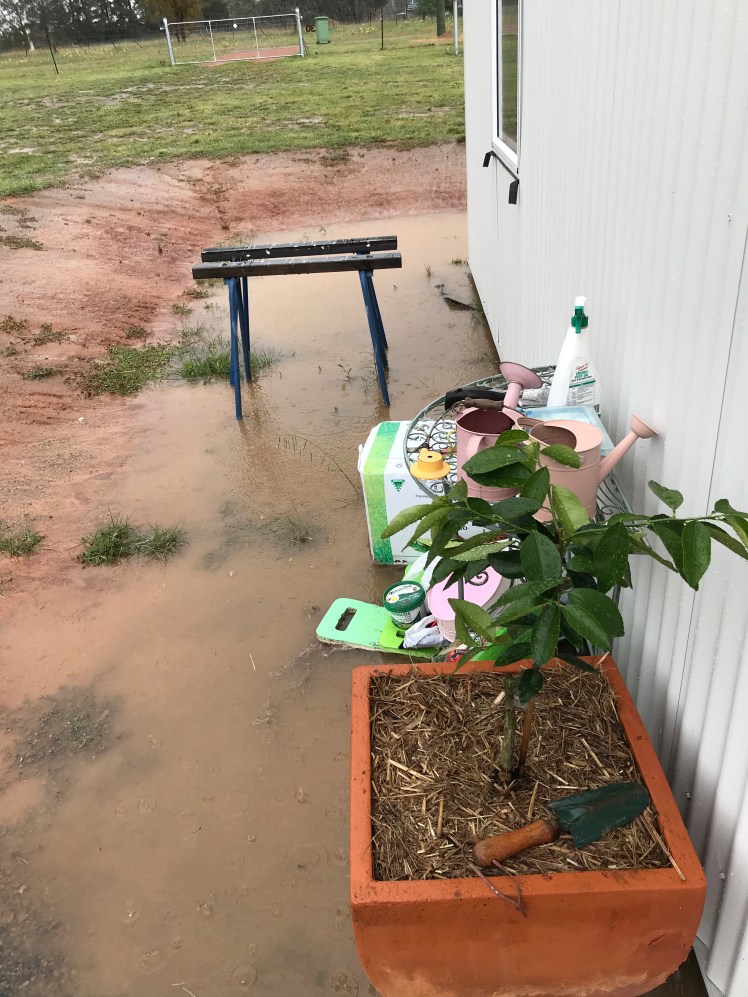
We also needed to sort out the surrounds of the house which, like all new builds, consisted of a lot of dirt and not much else. It was dusty in dry or windy weather, and sticky mud (and sometimes flooded) when it rained. We were planning a concrete patio across the back of the house and gravel around the other three sides, with a few pots here and there and a couple of small garden beds.
This photo gives you an idea of what the main entrance side of our house looked like after a big downpour:
But best intentions and all that, because what actually happened was that we hit the deck. We were completely spent from the previous four months of frantic building and moving, and when we realised how much effort is required to dig large holes in dried out clay soil and cart around enormous quantities of gravel, we threw a little tanty, picked up our toys and went home. We had already made gardening rookie mistake No. 1 by buying a bunch of trees and bushes long before we were ready to plant them, so we plonked seven of them in the huge garden bed we had set up for the septic system outflow, left the rest in pots, and then went inside and hibernated for the rest of the winter.
I have to say, the conviction we demonstrated over those next few months in justifying our complete avoidance of work was impressive. We told ourselves that we ‘really should’ clear all our short-term debt before spending any more money on the house, then we breathed a sigh of relief, locked up the tools and enjoyed a lovely few months making up for all the family time we’d missed during that frantic few months of building.
And the other unexpected upside was that, apart from a much-needed rest, it gave us an opportunity to really get a feel for living on the block, and determine what it was we actually needed and wanted in terms of landscaping. It resulted in some pretty big changes to our original plan, including to the design of Phase 2 of the house, and the lesson we learned is that, sometimes, being lazy can have its advantages.
Some of our discoveries included:
- it’s more windy than we realised. We are surrounded by beautiful open farmland and the wind has nothing to slow it down. It impacts the amount of dust being blown into the house, the comfort factor of outdoor entertaining areas, and the growth of many plants (including vegies and fruit trees) that are sensitive to wind. So we added several extensive windbreaks to the plan (around 160m of hedging in total).
- the Fishbowl Effect: with so few trees and 80 metres of street frontage, our whole block is able to be viewed from the road. I’ve never been a huge fan of conifers, but their frost- and drought-hardiness and ability to grow quickly and form a dense hedge has made them suddenly very attractive!
- internal space: we’ve realised we don’t need as much as we thought we did. The secret is the right storage – not just heaps of cupboards, which take up lots of space, but specific, tailored storage that has a place for everything. But I digress – back to landscaping!
Fast forward to spring and our one-and-only, albeit huge, garden bed had suddenly gone ballistic with weeds, and it was time to rustle up some energy and get moving. For context, it’s a 325m² raised and mulched bed with 140 plants to soak up the grey water. It was a requirement for our on-site septic system, otherwise it would not yet have existed. Unfortunately, in the race to tick all the boxes for our Final Occupancy Certificate, we had done a rush job on it and now we were, ahem.. ‘reaping’ the consequences.
We had used the leftover topsoil from our earthworks to raise the bed, and stockpiled cardboard (all those IKEA flat packs!) from the build to use as weed/grass suppression, but we only had enough to cover half the bed. We then had 18 cubic metres of mulch brought in (that’s two very large truckloads) which was only just enough to cover an area that size. There was no time to source another huge quantity of cardboard, so we hoped that the mulch covering would be enough to kill off all the grass and weed contained in the topsoil.
By spring, we learned just how effective cardboard is as a weed suppressant. Blind Freddy could see where the cardboard had been used, and where it hadn’t – it was a bit like looking at a patch of desert next to a jungle. So our first major landscaping job was to try and return the garden back to it’s former glory. Spoiler alert: the weeds won. Six months of gradually dwindling efforts on our part to beat the weeds were useless, and this is what it looks like now, over a year after we established it, with a fairly clear distinction between the ‘cardboarded’ areas and the remaining jungle:
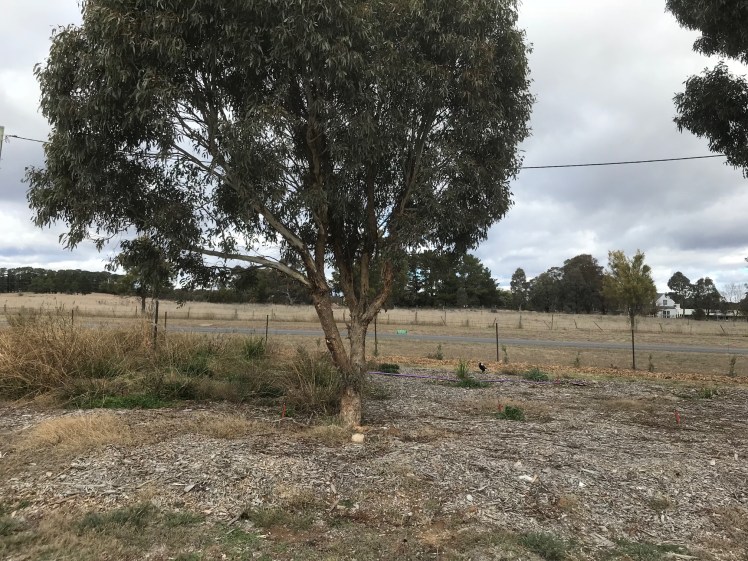
And so we learned rookie gardening mistake No. 2 the hard way: don’t cut corners when preparing a garden bed. It’s a mistake we won’t be making again anytime soon!
Our new toy
Once again though, there was an upside: the weed disaster helped us to justify buying a very exciting new toy to help us with our landscaping: a mini tractor!
Matt had always wanted a tractor, but we had agreed our block wasn’t big enough to justify one… until we realised the work that would be involved in turning our large, empty, clay-soil paddock into an attractive, green space with lots of trees and proper pathways and garden beds. For me this aspect is just as important as the house, and I was saying ‘Yes let’s buy one!’ before the words ‘I wish we had a tractor’ had even finished coming out of Matt’s mouth.
We had just refinanced our mortgage so that we could draw on the equity to pay for a shed, pergola, landscaping, and a new car, so we re-crunched the numbers and figured we had just enough left over to buy a second-hand tractor, if we could find one at a good price.
A few weeks later we were extremely lucky to find an almost-new one just up the road, going for a bargain as the owner was moving to Melbourne at short notice and needed everything gone. Happy days for us! It was put to work immediately and now we have no idea what we did without it: it carts firewood up to the house, has moved literally tons of soil, mulch and gravel around the block, and has enabled us to plant over 120 trees in the space of a few months. Our plan is to sell it in a few years when we are finished building Phase 2 of the house and the rest of the landscaping is done, but secretly I’m not sure if we’ll ever be ready to part with it!
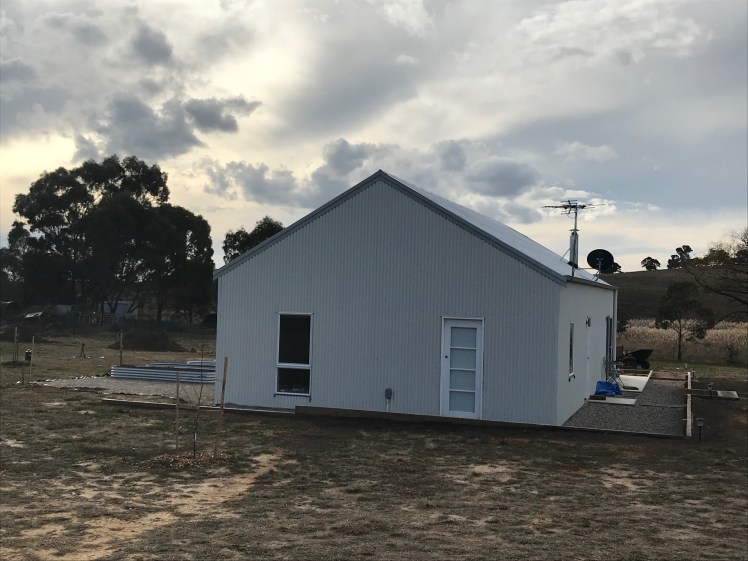
Here are a few photos of the work we did in the first few months of 2018:
Up and out of the mud
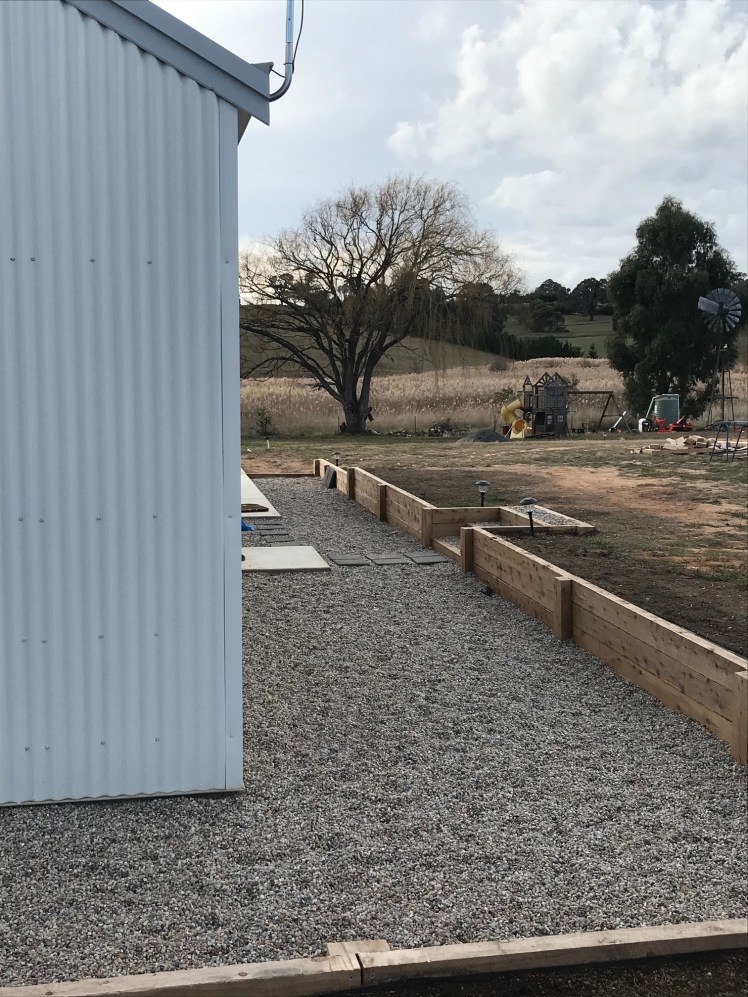
We finally got the external concreting done in January 2018, then used the tractor to dig out and flatten the dirt around the house, rip drainage trenches, dig the post holes for the retaining wall, and shovel all the gravel in. We also used it to back-fill against the retaining walls with gravel and soil. For the next few days we were like the guy in the Colorbond ad who keeps going outside to gaze lovingly at his roof – except we looking at our beautiful, gravelled, non-muddy ground.
Gardening: where to start?
I had been dreaming of a beautiful country garden around our house for a long time, and had lots of ideas about what I thought would look good. My stumbling block was where and how to start. The scale and emptiness of our block is a bit daunting: even our existing 325m² garden bed really didn’t look all that big in the scale of things, so we knew we had a substantial job ahead of us.
As we had done with our house build, we started talking to people who had lots more experience than us, and the invaluable information and advice we were given got us up and running with a plan.
Click here for lots of tips on starting a large garden from scratch.
The tractor’s next job was to get the windbreak around the orchard and veggie garden in.
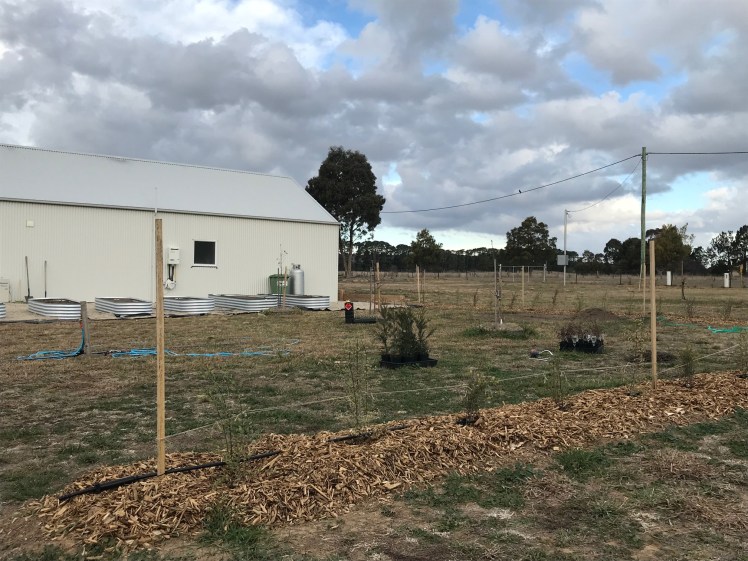
The beginnings of the orchard and veggie patch section
The garden bed you can see in the forefront of the above photo is a 40 metre L-shaped bed which will run along the south and west sides of the orchard and veggie patch area. This area is up against the west wall of our house, and the ‘open’ side of the area is on the north.
We used the rotary hoe attachment on the tractor to churn up the top layer of earth, then used the trench ripper attachment along the length of the bed a few times to break up the hard clay. We then used the front bucket to shovel in some better quality soil, then rotary-hoed it all again to mix it up a bit.
Then it was ready for planting – and this time we didn’t skimp on the weed suppressing material! (Newspaper for this one.)
UPDATE: we planted Silver Sheen Pittosporums for this windbreak as they thrived at our previous house. It hasn’t worked out well – we planted these ones in April, and within three months we’ve lost half of them. We’re fairly sure it’s because we have vastly different growing conditions on this block – it’s only half a kilometre from our previous place, but is so much more exposed to wind and frost. Boohoo. So we’re waiting till Spring and will plant something else.
Trees, trees and more trees!
With barely a pause it was onto the next planting job. This time it was our collection of deciduous trees that would be scattered around the block – it was very exciting to finally be making a bit of a dent in all the bare areas!
As these would eventually be large trees, and to give them a really good start, we used the tractor’s post hole digger attachment to drill several holes close together for each tree, then manually dug out the remaining dirt to create super-wide holes. We then used the tractor bucket to fill the holes with good garden soil, mixed in some existing soil, popped in the trees, and put a tractor bucket-load of mulch on each one. Easy peasy!
The big windbreak
Feeling more and more confident in our ability to knock over large garden jobs with ease, we took the plunge and bought 65 Leylandii Leighton Green conifers. These are used extensively in the Southern Highlands and Tablelands as hedges and windbreaks, as they are extremely fast growing (almost a metre per year in good conditions), hardy once established, and will form a lovely, dense, dark-green hedge (or windbreak if planted further apart). Although they have the potential to grow to 30 metres or more if left to their own devices, we’ve been assured that one or two pruning sessions per year will keep it under control. (Let’s hope this is right!).
We planted them 1.75 metres apart along most of our 80 metre street frontage, leaving some space either side of the front gate, and half-way (40 metres) down our east boundary, for privacy and for the windbreak effect.
To create good conditions for planting, we used the same process we’d used for the windbreak hedge in the orchard and veggie area, only this time we used long rolls of weed mat rather than newspaper or cardboard, due to the scale of the job.
Trusty the Tractor then carted all the mulch to cover the 120m garden bed and it was all done in a couple of days 🙂
The icing on the cake: veggie gardens!
We had been in a hurry to try and get all our trees planted before the winter frosts started, so we’d left the most exciting job until last: setting up the raised garden beds for our veggie patch!
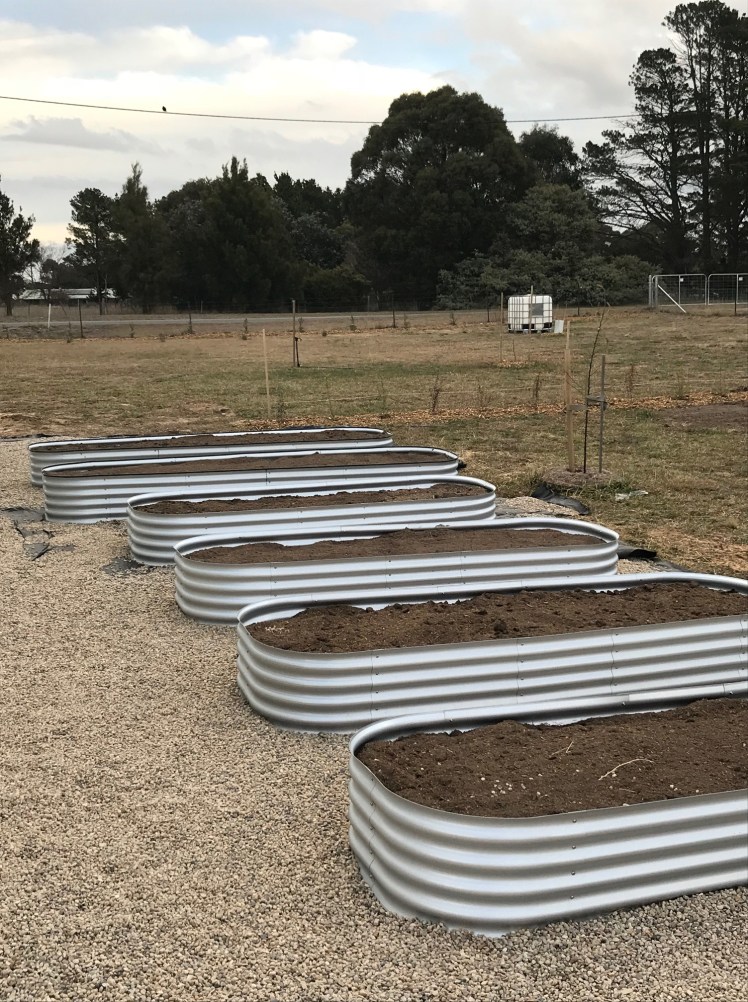
It would have been awesome if the tractor had an attachment that could do up the gazillion screws and bolts holding the beds together, but alas, we had to do that bit ourselves 🙂
The tractor came into its own though, when it was time to fill the beds with soil. We had purchased 4m³ of ‘veggie mix’ soil, and a very generous horse-owning neighbour had supplied us with a large trailer-load of partly composted manure, so we used the tractor bucket to mix the piles together, then fill the beds. Sooo satisfying to watch! We are going to grow some cracking organic veggies in these babies!
We then laid weed mat around all the beds and covered it in gravel to make the area look neat and tidy, and eliminate the need for weeding and mowing. We’re not quite finished around the edges yet, but we’re almost there.
And the original, huge, weed-infested garden bed that we used to help justify buying the tractor? It’s still overrun with weeds – we decided to wait till winter when most of the weeds would die off! Any day now we’re going to line up our trusty tractor and send her in to bulldoze that jungle. Hmmm… maybe next weekend…..
 Countrified
Nice update. Thanks. I know how frustrating weeds can be. Our property is in northern nsw and they grow as you watch them. We have 11 acres of paddock and bush gulleys. I’ve just purchase a flame weeder to see how that will tackle the weeds as I don’t wish to use glyphosate anymore.
LikeLiked by 1 person
I feel the same as you about glyphosate Judy, and I’ve heard those flame weeders are very satisfying to use! Our neighbour recently bought one but I haven’t seen it in action yet. I’d love to hear how you go with it. Our weed problems would be nothing compared to yours, with all your warm weather and rain – at least a lot of ours die off in winter! Have fun blasting them 🙂
LikeLike