Making a detailed budget for a DIY house build is not an easy task. At least, it wasn’t for us: budgeting and managing finances is NOT our forte, as you’ll soon discover! But if confessing our bumbling mistakes and oversights helps someone else in some small way, then they will not be in vain.
Well, there’s no point beating around the bush: here are the actual numbers, then I’ll explain a few things.
| Original budget: | Actual spend: | ||
| Governance | Termite protection | 0 | 755 |
| Governance | Owner builder insurance | 1000 | 0 |
| Governance | Surveying | 1000 | 660 |
| Governance | Council fees | 2535 | 2535 |
| Governance | Soil Report | 500 | 500 |
| Water | 115,000 litre water tank & install | 9050 | 9210 |
| Water | Hot water service (instant gas) | 900 | 900 |
| Water | Water pump | 500 | 1100 |
| Plumbing | All plumbing and tiling | 10000 | 15000 |
| Plumbing | Shower screen | 500 | 499 |
| Plumbing | Install Shower screen | 0 | 450 |
| Septic | Septic system/install | 12000 | 12000 |
| Earth works | Earthworks for house and watertank | 4500 | 4500 |
| Earth works | Trenching (for pipes) | 1500 | 1500 |
| Earth works | Sand, gravel, mulch | 0 | 4000 |
| Structure | Steel shed frame and cladding | 17525 | 17525 |
| Structure | Shed erection | 7010 | 8980 |
| Structure | Ceiling – zincalume & fasteners | 0 | 3000 |
| Structure | Fireplace, flue & installation | 3000 | 4300 |
| Structure | Insulation (Batts – walls and ceiling) | 1500 | 1830 |
| Structure | Attic ladder | 0 | 309 |
| Internal | Wardrobes, cupboards, blinds | 2000 | 4500 |
| Internal | Carpet – 32sqm (bedrooms) | 0 | 2500 |
| Framing | Internal wall frame timber/gyprock | 5000 | 7500 |
| Windows | Windows and doors | 5000 | 4060 |
| Paint | Paint, brushes, etc. | 1000 | 1200 |
| Kitchen | IKEA kitchen (flat pack) | 4000 | 5500 |
| Kitchen | Freestanding SMEG oven/cooktop | 2000 | 2350 |
| Kitchen | Rangehood + dishwasher | 1400 | 1200 |
| Bath | Tiles | 500 | 1165 |
| Bath | Toilet | 300 | 250 |
| Bath | Bath room mirror shaving cabinet | 250 | 229 |
| Bath | Tapware | 100 | 461 |
| Bath | Gas bottle | 100 | 200 |
| Bath | Bath | 200 | 0 |
| Bath | Vanity | 180 | 700 |
| Electrical | All elect. fit-out and connection | 5000 | 8072 |
| Electrical | Ceiling fans (inbuilt lights) | 600 | 475 |
| Electrical | IXL-Tastic light/heater for bathroom | 300 | 200 |
| Electrical | Antenna | 250 | 250 |
| Electrical | Lights (all other) | 500 | 500 |
| Electrical | Airconditioner / installation | 3000 | 2600 |
| Slab | House slab | 16370 | 12000 |
| Tooling | Karcher, miscellaneous hardware | 0 | 1000 |
| Original budget: | Actual spend: | ||
| Totals | 123,070 | 146,465 |
First of all, you can take $25-30K off that bottom line if you don’t need an enormous water tank and an on-site septic system.
Secondly, our shed has a 100m² footprint (13.2m x 7.6m) plus a mezzanine level (32m²) and obviously costs will vary accordingly for different sized sheds.
And with no other caveats to hide behind, there’s no hiding the fact that we went quite a way over our original budget! (19% over, but who’s counting? Clearly we weren’t.) You can easily see where we didn’t account for a few big-ticket items (the zincalume ceiling, sand/gravel/mulch, carpet in the bedrooms…) and where we either grossly underestimated the cost of others, or decided to spend more than we budgeted for (plumbing and tiling, taps, wardrobes…).
The numbers may also be useful to identify areas in which you could reduce costs, depending on what your purpose is. The obvious ones from our list are the kitchen (you may not need a big one, and alternatively there are plenty of second-hand kitchens for sale for a fraction of the cost of a new one), the carpet (we chose 100% wool), the oven (we’ll move this one into the forever kitchen, and the cabinets will also be re-used in the new kitchen or butler’s pantry), the tiles, the bathroom vanity.
There were a few other indirect building costs, mostly relating to council or building regulation requirements, that aren’t listed here. One was the need to have a toilet on site – we didn’t, so we had to hire a portaloo for three months. Another was the need for erosion control fencing – a waste of time and money on our large and gently sloping site, but there was no getting around it. It was only a couple of hundred dollars in materials, but half a day of my time laying it out and digging it in. The building site may also be required to be fenced during the construction, which is an additional hire or purchase cost if there’s no existing fencing in place.
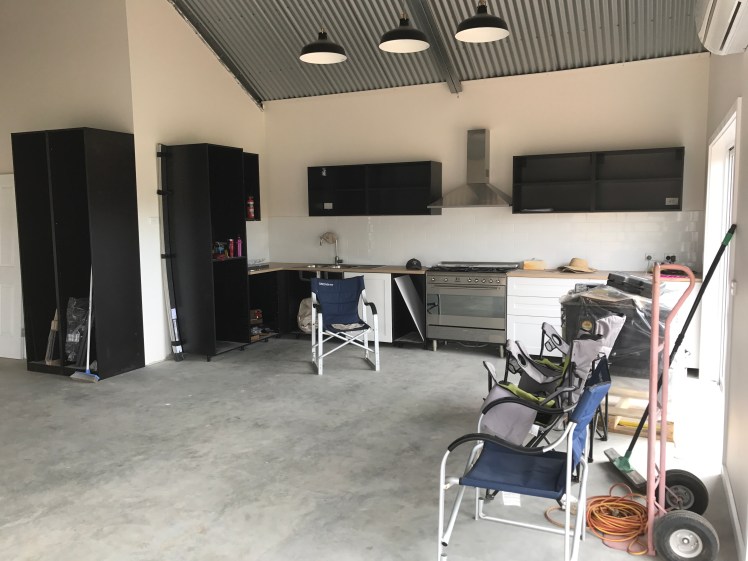
A couple of other tips based on our experience (AKA ‘a list of our stuff-ups that you can learn from’):
- We strongly recommend NOT forgetting to organise owner-builder’s insurance. Thankfully we didn’t have to learn this one the hard way, but it makes me shudder to think what the outcome might have been if someone had had an accident while working on our site. We were just bloody lucky.
- Have the biggest contingency fund you can possibly muster – and maybe some other back-up options too! Towards the end of the build, all the ‘little’ unforeseen costs* really added up, and on top of our reduced cash flow from both of us having taken time off work, we ended up having to sell the few shares we owned AND borrow $5K from my parents! It was a point-in-time issue and we were able to recover quickly, but still, we would have had some very irate suppliers if not for those fall-back options.
- We skimped on two things that we now regret: the sliding doors, and the toilet. The sliding doors have cheap fiddly locks that give us endless grief, given that we are going in and out of them multiple times each day. And the toilet… well, without going into the gory detail, it just doesn’t flush effectively! I thought it was ludicrous to spend up big on something like a toilet, but I had no idea there could be such variation in their performance. My new benchmark is that if you need to clean your toilet more than once a day, it’s probably fair to say it’s a dud. Next time around we’re going for the duck’s nuts toilet model, whatever that is.
- Tooling costs: drill bits (these break a lot!), paint brushes, drop sheets, sand paper, bolts, screws, nails, adhesive, gap filler, tape measures, leather gloves, face masks, safety goggles, work boots, etc., not to mention all the tools (screwdrivers, wrenches, drills, saws, hammers, etc.) added up to a lot more than we expected. And we had a lot of it already! Budget at least a few thousand for these if you are starting from scratch. In our experience it was money well spent to have the right tools – and good quality ones – as they really do save time and energy. I only wish I had applied this philosophy when choosing a toilet.
Hot tip: have enough common tools (hammers, tape measures, stanley knives, etc.) so that there is one for every worker on site, plus a spare or two. Trying to share a hammer or find a stanley knife when you need one wastes time and, more importantly, drives everyone nuts.
- Pay invoices immediately. It helped us keep on top of our financial situation (well, ok, that’s laughable, but it would have been even worse at the end if we hadn’t! See below), but mostly, it improved the relationship with our tradies. Everyone that worked on our build had experienced endless and stressful cash flow issues in the past, with customers taking weeks to pay for materials that the tradie was out-of-pocket for. Paying invoices the same day built trust and I believe made them more enthusiastic about working on our job.
*Some of the ‘little’ unforeseen costs toward the end of the build were:
- We had bought a fireplace, but forgot about the flue: $800
- We needed special flashing to install the flue in our non-conventional ceiling: $450
- We thought we could install the frameless shower screen ourselves, but realised we had no idea what we were doing: $450
- All the service connection costs and deposits (gas, electricity, phone/internet): $can’t recall but several hundred sounds about right
- The late addition of 100% wool carpet for the bedrooms: $2500
- The overspend on wardrobes and blinds: $2500
- Two enormous truckloads of mulch to meet the requirements for the septic irrigation area: $1400
So there it is, the slightly humiliating story of our financial ineptitude. If there is anything you’re wondering about that I haven’t mentioned, just drop me a line and I’ll answer as soon as I can. Happy budgeting!
 Countrified
Uh oh! I need to sharpen my pencil. I appreciate you sharing your experience with us.
LikeLiked by 1 person
My pleasure Judy 🙂 I hope you’re having fun designing yours!
LikeLike
Great information! Will use alot of these tips when building my own/
LikeLike